Sunday, August 22, 2010

Shoulder-to-shoulder

Imagine you live in a country the size of New Brunswick, but inhabited by half the population of Canada. The people are generally very friendly, but you are constantly bombarded, shoulder-to-shoulder, by people every day. Everyone knows where you live before you tell them – taxi drivers, colleagues and new friends.

When you leave your house each morning, people shout “How are you?” from across the road as you approach your bus stop. You are in a good mood that morning so you wave, smile and return the question. One member of a group of girls walking slowly in front of you sees that you are behind her. She taps her friends on the arm and they both look at you and giggle. Soon they are all quietly laughing but you aren’t sure why. You laugh to yourself.

When you reach the bus, you climb on, catching the sleeve of your shirt on a bar that is sticking out of one of the benches. Luckily, you are able to maneuver it without tearing the material.

You crawl over a woman and her four-year-old child, who is perched on her lap, and settle yourself on the bench with two men on your other side. You have to duck your head down and pull your knees up toward your chest, as you are slightly too big for the space that you have squeezed yourself into.

As the bus pulls over to your stop, you tell the woman that you must crawl over her once again. You stumble out of the bus – all eyes on you – bumping your head on the ceiling. The man you were sitting beside is following behind you and as you rub your head, he says “oh, sorry white person.” You smile politely and hurry off to work.

As you rush past everyone around you, you wonder why everyone is taking their time getting to work. Won’t their superiors be upset if they are late? People come in and out of your office all morning, either to ask questions or just to say hello and stare at you. Finally, it is lunch time.

As you enjoy your meal, a group of children sit outside the window. They are waiting for your leftover food. You have mistakenly built an expectation in their head since the first week you were living in the densely populated town. You selfishly wish that you hadn’t given them your leftovers that first week because now you feel guilty finishing any of your meals.

As you leave the restaurant, you pass off the remainder of your lunch to the children and head back to work. After working the entire afternoon, it is time to go home. A colleague stops you on your way out. “Where have you been hiding?” he asks cheekily.

You reply, “Didn’t we see each other a few hours ago?” “Oh yes, that’s right. Let’s have lunch tomorrow,” he says as his eyes trace the length of your body. You scurry off again.

As you walk home, your phone rings. It’s an obnoxious ring tone but you have never been able to figure out how to change it. You answer. It is a new friend of yours, “Hey, I saw you walking down the road at 11:55 today.” You wonder why they didn’t say hello but you receive so many calls and texts like this each week that you have given up asking such a question.

You arrive home at 4:15 p.m. and your neighbours notice that you are home 15 minutes earlier than normal. They make a point to verbally recognize this. At this stage of the day, you want to say, “So what?! I am tired today!” But again, you politely smile, shrug your shoulders and walk up the driveway.

After supper, you crawl into bed, only to wake up into your nearly-celebrity-status life all over again.

Sunday, August 15, 2010

"Flash me"

Since arriving in Malawi, I have flashed—and been flashed by—many people. Oddly enough, flashing one another is a crucial aspect to forming friendships within this country.

Each time I meet someone new that I want to continue a friendship with, we flash each other. It’s quick and easy and it automatically guarantees a response—typically a smile of approval.

Over the past month I have flashed and been flashed by about 30 people—Malawians and expatriates, taxi-drivers and co-workers, women and men. But I have yet to be flashed by any children.

Aside from the initial meet-and-greet if you flash your new friend it is sometimes considered rude. It’s a teaser. It means, “I want your attention but I’m not willing to go all the way.”

For some reason though, it is acceptable for some Malawians to flash their expatriate friends but if a Canadian flashes another Canadian, it’s scandalous and you can be sure that everyone will be talking about it. A typical response to flashing within the expatriate community is dismissal with a hint of resentment.

Living in a large house with four other Canadian girls ensures some minor flashing, if only to get each other’s attention.

On one occasion, I was flashed by mistake and although it was embarrassing for the other person to admit to it, the act itself became amusing. In jest, I flashed back—only furthering the humiliation of my friend.

Flashing v. (flăsh’ĭng): A request to be called back by dialing and immediately hanging up. Typically used to save money on cell phone airtime. Commonly misinterpreted as the act of indecent exposure.

http://www.jhr.ca/blog/2010/08/flash-me/

Thursday, August 12, 2010

Who Can Fight for Me?

A few days ago, fellow jhr intern Amy and I were sitting comfortably in our office at the Malawi Institute of Journalism (MIJ) when a student named Charles Chaswa knocked politely on the door before letting himself in.

He passed us a piece of paper and spoke softly to us, saying that he had to leave MIJ because his sponsor had died and he could no longer afford the school fees.

Chaswa, a student at MIJ in the yearlong Certificate program, is required to pay K 210,000 ($1,500 CAD) per semester before exam time. And fees rise for senior-level Diploma students, as they pay K 315,000 ($2,250 CAD) per semester in the program that lasts one and a half years.

In addition to these prices, the students are asked (but often not expected) to supply their own cameras and recorders but many cannot afford to purchase such equipment either.

Chaswa’s letter explains that his mother passed away while he was in primary school and soon after, his father passed away while he was in secondary school. He writes with hope, “I try to pray that God turns my darkness into light.”

Because the government only pays for public primary school, Chaswa could only pray for his secondary school fees. He and two other children received a plot of land as an inheritance from his father, they split the money and with his share, Chaswa was able to complete secondary school. To his dismay, Chaswa only had K 60,000 ($428 CAD) remaining as he entered the journalism course at MIJ.

But Chaswa’s passion made him fight harder for his education. He explains in his letter that he requested sponsorship from his church, banks, radio stations and the Bingu Silva Foundation. But his requests went unanswered.

Among the 150 certificate students and 100 diploma students at MIJ, Chaswa is not alone in his plight.

Dalitson Nkunda, Course Manager at MIJ, explained that 10 to 15 percent of students drop out due to lack of funds to support their education. “Many students attend all of their classes and are not able to write the exams at the end of the semester,” she says, clarifying that the students often search in vein for sponsors throughout the school year.

As a Rights Media Educational Officer, I have little power to assist the students in this way. My role with Journalists for Human Rights (jhr) requires me to adhere to their core principles. The final clause states, “jhr is an organization that does not provide monetary support to media houses.” And I certainly don’t have the personal funds to support even one student.

I think back to my time at university and although the debt from student loans is looming over my bank account, I am grateful that I had the relatively easy opportunity to acquire funds for my tuition.

Chaswa’s story is both compelling and heartbreaking. And I feel nearly helpless. The only way I know how to assist students in this situation is to bring awareness to the issues that many Malawians face. Frankly, Chaswa exceeded beyond many others, in that he found a way to complete his secondary school despite the death of both of his parents.

The eager student closes his letter by wondering, “Who will fight better for me? I struggle to find peace, freedom and love in order to have strength of mind.” Realizing that his dreams of journalism have been dashed, he asks, “Where can I go to find help?”

For photos: http://www.jhr.ca/blog/2010/08/who-can-fight-for-me/

Friday, August 6, 2010

Creating Facebook albums one child at a time

Blantyre is a photographer’s dream. The rolling hills, multi-coloured birds and salamanders, Lion King-style trees and bustling markets provide great scenery for a 4x6. Adorable children that dance around and play with homemade toy cars on dusty roads complement the ambiance of Malawian life. But on occasion, conditions do arise for photographers in this blissful paradise.

During a recent trip to the picturesque Mount Mulanje, my colleagues and I bypassed the lengthy trek up the mountain and stopped in a small town for a late lunch instead. As we approached Pizza Basilica, we met a group of young children.

We all had our expensive digital cameras out, snapping shots of the gorgeous mountain behind the pizza parlour, when the curious children approached us. We automatically started capturing them on our cameras and in return, showed them the pictures and videos we were taking.

I went through a nearly identical occurrence in Uganda last year and I have always felt uncomfortable with it. Perhaps I become irked by the idea of photographing children because of how it is treated in Canada – in that, we are expected to obtain permission from the guardians. Or maybe I let it get to me when the phrase “poverty tourism” rings through my head whenever I capture an every-day moment for a Malawian that I believe is quaint.

Yet, I pushed past my discomfort and continued on, with surprising delight, as I captured many endearing photos.

The shrieking laughter of the kids, as they hopped around excitedly, told us that they were enjoying the experience just as much as we were. Mission complete: no strenuous mountain climbing, great photos and we made a group of kids smile.

Sounds like a perfect Facebook album right? Upload the photos, slap a few song lyrics on as the title, and call it a day. But it’s not always that easy. Although it is not unlawful to photograph children in Malawi, expectations often arrive in various forms.

The Malawi Code of Ethics merely states that “children under the age of 13 who are involved in cases concerning sexual offences, whether as victims, witnesses or defendants” shall not be identified through any published material. Yet, this clause is only considered a moral guideline and is the only section that refers to children’s rights within the document.

Similarly, in the Human Rights chapter of Malawi’s Constitution, article 35 and 36 encourage freedom of expression and freedom of the press. Malawi’s penal code does not appear to address the issue of photographing children.

Despite these documents, there are still conditions that lie within the photography realm of Malawi.

After our mini photo shoot, a group of men approached us saying that we needed to give the children money in return. Feeling intimidated, we awkwardly passed over a few coins and small bills.

With confusion in their eyes, the children waved goodbye to us as we hurried off to catch the next minibus. As toddlers, I’m not sure if they put the pieces together as to what had just happened. After we left, I was just as baffled as the children were at what had just occurred.

Whether the money stayed in the hands of the children or not, is beyond my knowledge. But I came out with a few incredible photos and sure enough, I posted them to Facebook during my next available weekend.

Note: I submitted this blog post to the jhr site but had to change it around a bit so that it fit with jhr's policies. See if you can spot the differences in the edited version: : http://www.jhr.ca/blog/2010/08/a-photographers-paradise/

Sunday, August 1, 2010

Patrick's Pizza

I have been craving cheese since my first week in Malawi. It's a rare commodity in our home and although it is surprisingly easy to find at the supermarket, it's rather expensive.

Because luxuries like cheese are not built into our food budget, a couple of days ago I sprang K1,500 (10.71 CAD) for a few blocks of creamy, delicious, amazing cheddar cheese. And so, we made pizza.

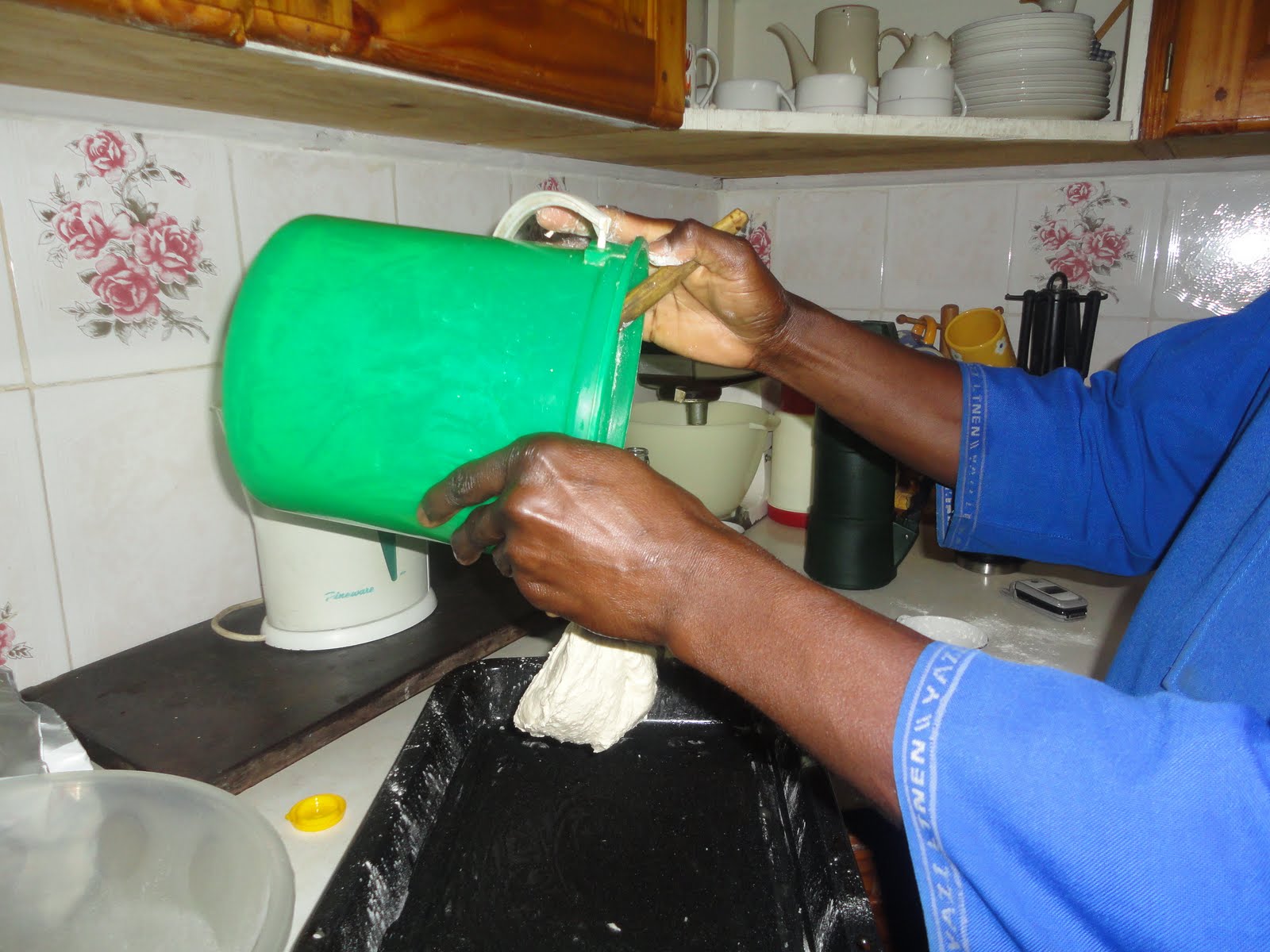
Patrick (our incredible cook who I will tell you more about later) and I made pizza from scratch. Rather than describing the process, check out these photos.


I know that making pizza isn't exactly blog-worthy for my fellow Canadians but it is when you eat beans/peas and rice every night in Malawi and all you want to do is bite into a huge block of mozzarella.

Now, please step away from your computer and go eat some cheese.

Friday, July 23, 2010

Discovering success at MIJ


Two years ago, Simona Siad began her jhr internship at The Daily Times in Blantyre, Malawi. After a few months, her efforts extended beyond the newsroom to a classroom down the road at the Malawi Institute of Journalism (MIJ).

“The classroom was a really unique place to work with young journalists on human rights issues,” proclaims Siad. To this day, her impact resonates among MIJ students.

Archibald Kasakura, a 30-year-old diploma student at MIJ, shares the impact Siad had on his journalism skills. “Before she came onto the scene, I didn’t know how to write features,”Kasakura recalls, “Simona made me what I am today.”

When Kasakura first started writing, he relied on Siad for about 70 percent of his work. “Initially, I thought she was being so hard on me, but now I know it was part of the growing process,” he says. But these days, Kasakura works independently at producing high-quality stories on a regular basis.

Over the past couple of years, Kasakura has written nearly 40 articles. After his first article was published, the ambitious student said that he “gathered the courage to keep writing.” Focusing on human rights features, Kasakura has published stories on children’s rights (issues of forced labour and sexual abuse), the rights of prisoners living with HIV, the right to religion and free primary education, and most recently, Malawi’s development since independence in 1964.

Keen to expose human right issues, Kasakura uses his downtime between classes to freelance his articles. Writing on a nearly broken-down laptop that he borrows from his uncle, Kasakura recognizes the value of his work.

“I used to see human rights as something that doesn’t apply to Malawians, but now I see the importance of them,” he states. “[Simona] has opened my eyes.”

Siad and Kasakura worked toward making everyone on the world fully aware of their rights–at the core of jhr’s mandate. She remembers him fondly, “Archibald is a really special student…I could tell right away that he had an incredible enthusiasm for human rights reporting.”

Kasakura says, “As a reporter, I have a duty to see that human rights of Malawians are respected.” He firmly believes that writing such stories will create change.

Initially, Kasakura wanted to become a lawyer but he was always interested in writing. Upon being rejected from law school and receiving alternate suggestions that he study journalism, he decided to enroll at MIJ. Looking around the office, Kasakura declares with poised confidence, “This is where I belong.”

Thursday, July 22, 2010

Bobby pins galore

For a less enlightening post: